Data Integrity for Data Pipelines
Show text version
01
Your pipeline, as it runs today
Every task ran, on time, in order. The value is wrong and nothing errors.
02
mmune validates every hop
Compares what arrived with what left. No rules to write; the baseline is the rule.
03
The finding, not the log hunt
One finding per root cause, with the evidence, routed to the team that owns the hop.
mmune
mmune
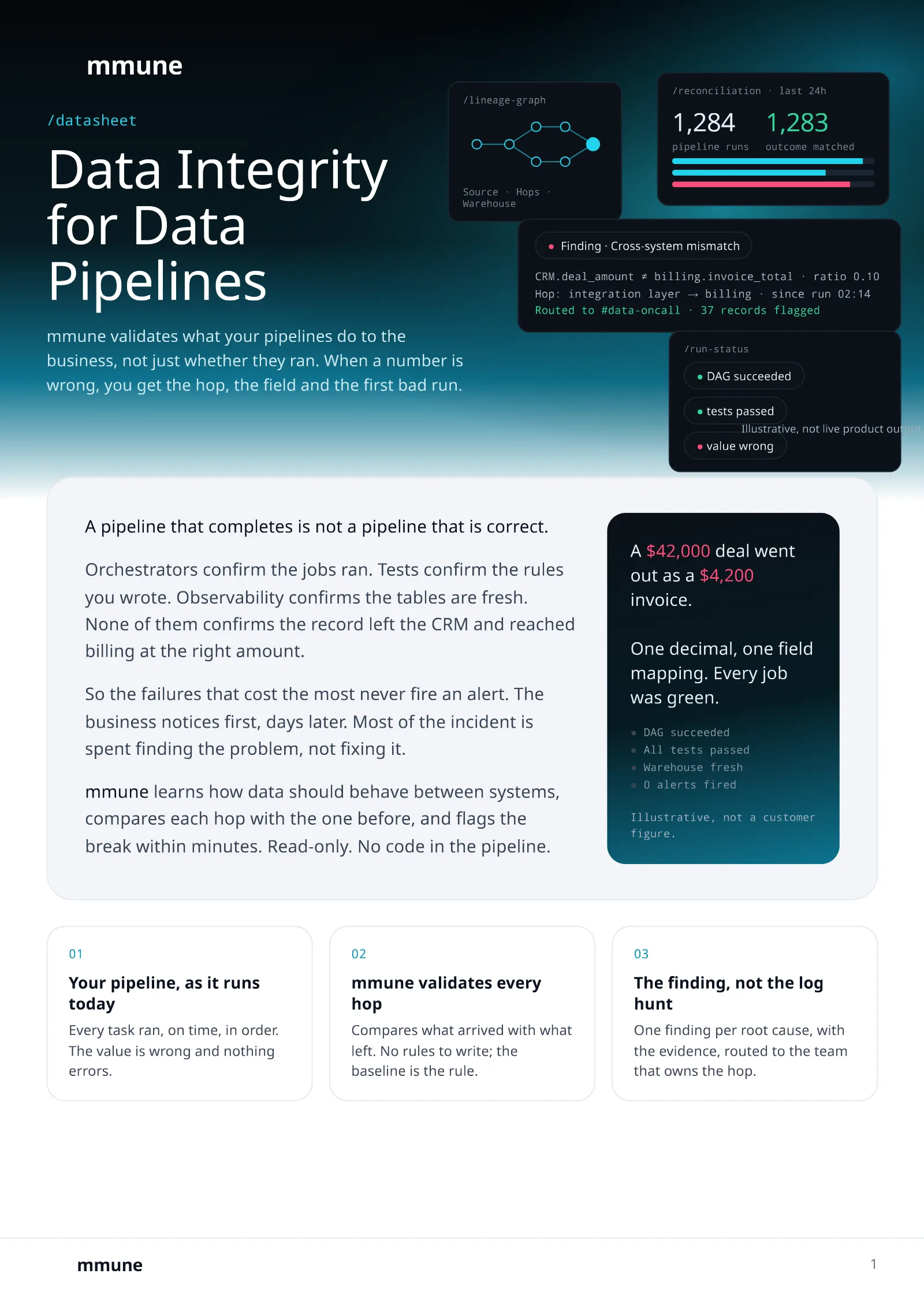
/lineage-graph
Source · Hops · Warehouse
/reconciliation · last 24h
1,284
pipeline runs
1,283
outcome matched
- Finding · Cross-system mismatch
CRM.deal_amount ≠ billing.invoice_total · ratio 0.10 Hop: integration layer → billing · since run 02:14 Routed to #data-oncall · 37 records flagged
/run-status
- DAG succeeded
- tests passed
- value wrong
Illustrative, not live product output.
/datasheet
mmune validates what your pipelines do to the business, not just whether they ran. When a number is wrong, you get the hop, the field and the first bad run.
A pipeline that completes is not a pipeline that is correct.
Orchestrators confirm the jobs ran. Tests confirm the rules you wrote. Observability confirms the tables are fresh. None of them confirms the record left the CRM and reached billing at the right amount.
So the failures that cost the most never fire an alert. The business notices first, days later. Most of the incident is spent finding the problem, not fixing it.
mmune learns how data should behave between systems, compares each hop with the one before, and flags the break within minutes. Read-only. No code in the pipeline.
A $42,000 deal went out as a $4,200 invoice.
One decimal, one field mapping. Every job was green.
- DAG succeeded
- All tests passed
- Warehouse fresh
- 0 alerts fired
Illustrative, not a customer figure.
/failure modes
The failures your tests were never written for
VALUE MUTATION
Right schema, wrong number
Type checks pass. Row counts match. The amount is 10× off.
SILENT FIELD DROP
Loads succeed, totals drift
A field goes empty upstream. Nothing fails. Sums stop adding up.
DUPLICATE · STALE RESEND
Counted twice, dated today
Yesterday's batch, today's timestamp. Revenue is doubled.
CROSS-SYSTEM DESYNC
Two systems, two truths
CRM says closed, ERP says open. Both are consistent. The process is not.
/on-call
What changes for the on-call engineer
Before
With mmune
Hears from the business, days later
Finding within minutes of the bad run
Starts from "the Q3 number looks off"
Starts from the hop, the field, the first bad run
Pulls logs from five systems by hand
Correlation arrives done, evidence attached
Guesses what to re-run
Affected tables, jobs and records listed
Writes one more test
The baseline already covers the next variant
mmune
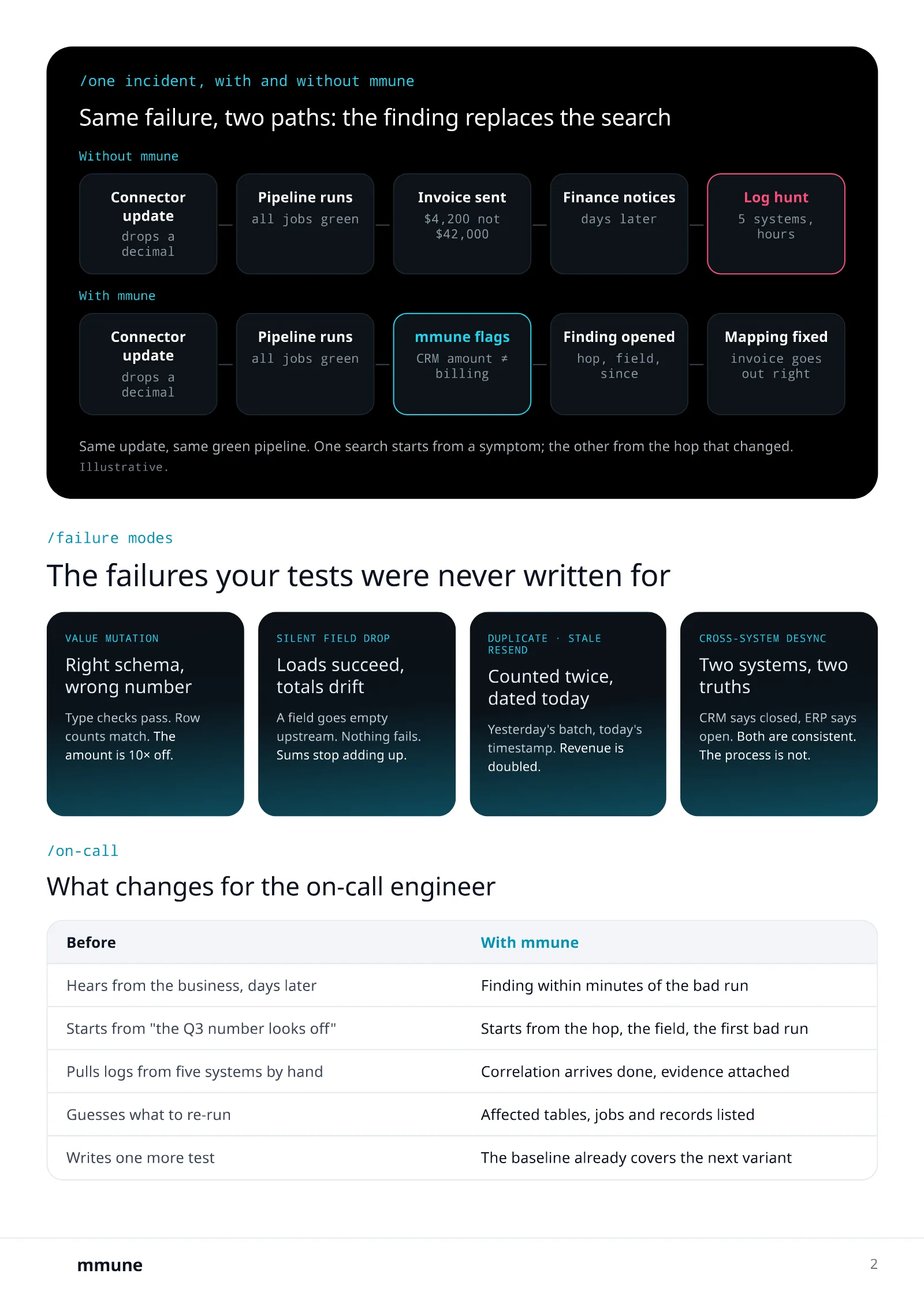
/one incident, with and without mmune
Same failure, two paths: the finding replaces the search
Without mmune
With mmune
Same update, same green pipeline. One search starts from a symptom; the other from the hop that changed.
Illustrative.
Connector update
drops a decimal
Pipeline runs
all jobs green
Invoice sent
$4,200 not $42,000
Finance notices
days later
Log hunt
5 systems, hours
Connector update
drops a decimal
Pipeline runs
all jobs green
mmune flags
CRM amount ≠ billing
Finding opened
hop, field, since
Mapping fixed
invoice goes out right
/capabilities
For the pipeline, and for the people who run it
Check the outcome, not the run
Replace the log hunt
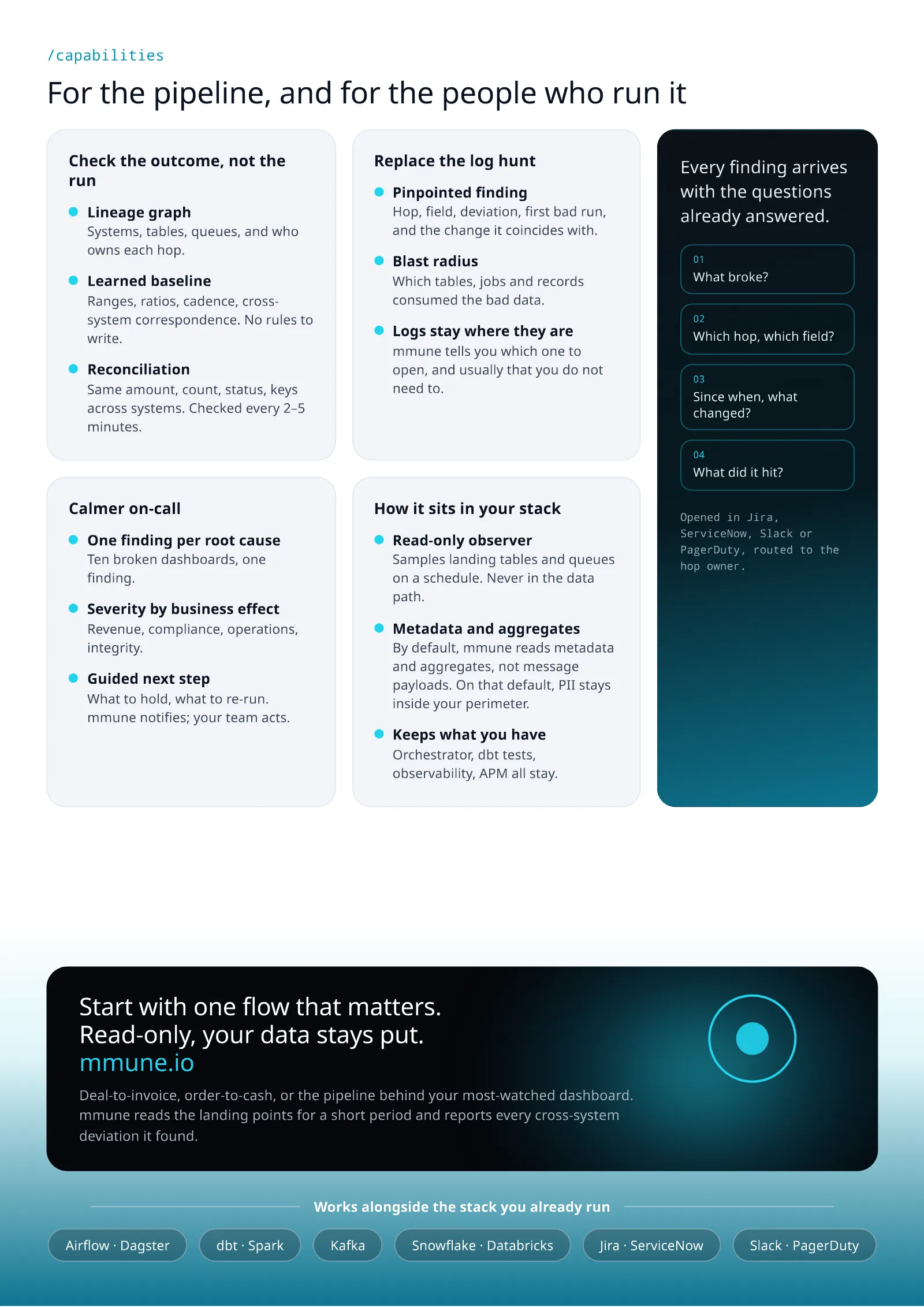
Every finding arrives with the questions already answered.
01
What broke?
02
Which hop, which field?
03
Since when, what changed?
04
What did it hit?
Opened in Jira, ServiceNow, Slack or PagerDuty, routed to the hop owner.
Calmer on-call
How it sits in your stack
Lineage graph
Systems, tables, queues, and who owns each hop.
Learned baseline
Ranges, ratios, cadence, cross-system correspondence. No rules to write.
Reconciliation
Same amount, count, status, keys across systems. Checked every 2–5 minutes.
Pinpointed finding
Hop, field, deviation, first bad run, and the change it coincides with.
Blast radius
Which tables, jobs and records consumed the bad data.
Logs stay where they are
mmune tells you which one to open, and usually that you do not need to.
One finding per root cause
Ten broken dashboards, one finding.
Severity by business effect
Revenue, compliance, operations, integrity.
Guided next step
What to hold, what to re-run. mmune notifies; your team acts.
Read-only observer
Samples landing tables and queues on a schedule. Never in the data path.
Metadata and aggregates
By default, mmune reads metadata and aggregates, not message payloads. On that default, PII stays inside your perimeter.
Keeps what you have
Orchestrator, dbt tests, observability, APM all stay.
Works alongside the stack you already run
Airflow · Dagster
dbt · Spark
Kafka
Snowflake · Databricks
Jira · ServiceNow
Slack · PagerDuty
Start with one flow that matters. Read-only, your data stays put. mmune.io
Deal-to-invoice, order-to-cash, or the pipeline behind your most-watched dashboard. mmune reads the landing points for a short period and reports every cross-system deviation it found.